Introduction
Affidavits play a crucial role in the Indian legal system. Whether you are filing a case, applying for a document, or submitting proof to a government office, a properly drafted affidavit holds significant weight in court proceedings. But many people wonder: what is the legal validity of affidavit in court India?
At Draft My Documents, we specialize in preparing affidavits that are legally valid and recognized in courts across India. With our expertise, you can ensure your affidavit is not only accurate but also fully compliant with legal standards.
In this guide, we will explain the concept of affidavits, their legal validity in India, key requirements, and best practices for ensuring your affidavit is accepted in court.
What is an Affidavit?
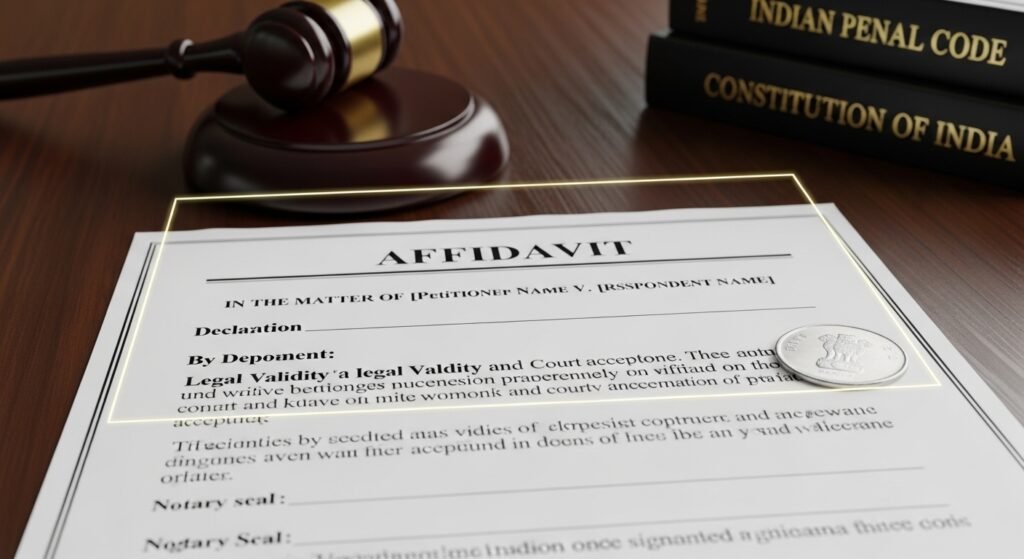
An affidavit is a written statement made under oath or affirmation before a notary public or magistrate. It is a legal document where the declarant promises that the contents of the document are true to the best of their knowledge. Affidavits are widely used for:
- Court cases and legal disputes
- Property transactions
- Name change or address proof
- Loan applications
- Government and administrative procedures
Legal Framework Governing Affidavits in India
Affidavits Under the Indian Evidence Act
Under Section 193 and 196 of the Indian Penal Code, providing false information in an affidavit is considered perjury. This emphasizes the seriousness of affidavits in legal proceedings.
Notarization and Jurisdiction
- Affidavits must be notarized or attested by a competent authority.
- For court use, affidavits should be submitted in accordance with court rules and formats.
- A proper affidavit ensures that your statements are considered legally valid evidence.
Key Components of a Legally Valid Affidavit
To ensure your affidavit has legal validity in court India, it must include:
- Title of the Affidavit – Clearly mention the purpose (e.g., Affidavit for Name Change).
- Personal Information – Name, address, age, and occupation of the declarant.
- Statement of Truth – A declaration that the information is true to the best of your knowledge.
- Oath or Affirmation Clause – Signed in front of a notary or magistrate.
- Signature and Date – The declarant must sign, and the affidavit should be dated.
- Notary/Authority Attestation – Confirms authenticity and legal recognition.
At Draft My Documents, we ensure every affidavit meets these legal criteria, so it is fully valid for court submissions.
Types of Affidavits Accepted in Court
Common Affidavit Types
- Affidavit for Name Change – Used when changing a name in official records.
- Affidavit for Address Proof – Provides proof of residence for legal or administrative purposes.
- Affidavit for Property Ownership – Confirms ownership or rights over property.
- Affidavit for Court Cases – Sworn statement used as evidence in civil or criminal matters.
- Affidavit of Relationship – Confirms family relationships in legal proceedings.
How Courts Treat Affidavits
- Affidavits are considered evidence in court if notarized correctly.
- False statements can lead to legal penalties, including imprisonment for perjury.
- Courts verify the authenticity of affidavits through notarization and the declarant’s oath.
- Affidavits can be used as supporting documents in various applications or cases.
For practical guidance on affidavit use in courts, you can refer to Indiacode Legal Portal.
Drafting a Legally Valid Affidavit
Steps to Ensure Legal Validity
- Consult Experts – Professional legal drafters like Draft My Documents help you avoid errors.
- Use Standard Format – Courts may reject improperly formatted affidavits.
- Include All Relevant Details – Omit no essential facts or declarations.
- Notarization – Ensure signature verification and authority attestation.
- Keep Copies – Always keep multiple notarized copies for submission and records.
FAQs About Legal Validity of Affidavits in Court India
Q1: Can I submit an affidavit without notarization in court?
A: No. For legal recognition, affidavits must be notarized or attested by a competent authority.
Q2: Is an affidavit valid if submitted online?
A: Some courts accept digitally signed affidavits, but most require physical notarization.
Q3: What happens if the affidavit contains false information?
A: Submitting false information can lead to perjury charges under Indian law.
Q4: Can a draft affidavit from a professional service be trusted?
A: Yes, services like Draft My Documents ensure affidavits meet all legal standards for court validity.
Conclusion
Affidavits are legally binding documents in India, and their validity in court depends on proper drafting, notarization, and truthful declarations. Using expert services like Draft My Documents ensures your affidavit meets all legal requirements, minimizes errors, and is fully recognized in court proceedings.
Take Action: Don’t risk legal complications—consult Draft My Documents today for a professionally drafted affidavit that is fully valid for court use.
Contact Draft My Documents: