Introduction
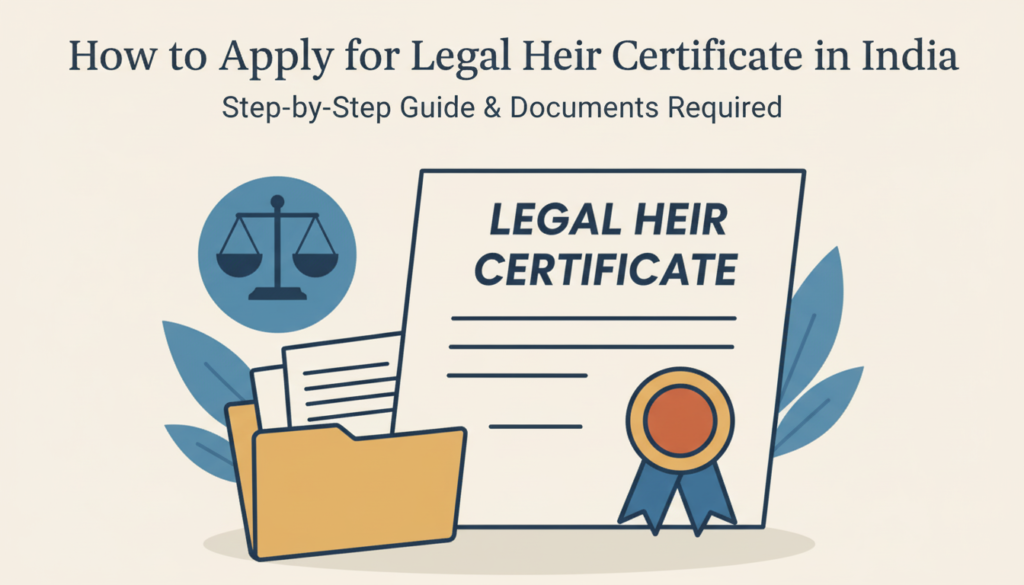
When a loved one passes away, dealing with legal and financial matters can feel overwhelming. One of the most important documents you may need is a legal heir certificate. If you are unsure how to apply for legal heir certificate in India, you are not alone.
This guide simplifies the entire process—from eligibility and required documents to online and offline application steps—so you can complete it without confusion or delays.
What is a Legal Heir Certificate?
A legal heir certificate is an official document issued by government authorities to identify the rightful heirs of a deceased person.
Why is it important?
You will need it for:
- Claiming bank deposits
- Transferring property ownership
- Pension and insurance claims
- Government benefits
- Utility transfers
Without it, accessing assets or settling legal matters can become complicated.
Who Can Apply for a Legal Heir Certificate?
Before learning how to apply for legal heir certificate in India, you must confirm eligibility.
Eligible applicants include:
- Spouse of the deceased
- Children (son or daughter)
- Parents
- Siblings (in some cases)
Documents Required for Legal Heir Certificate
Preparing documents in advance will save you time and prevent rejection.
Mandatory documents:
- Death certificate of the deceased
- Identity proof of applicant (Aadhaar, PAN, Voter ID)
- Address proof
- Ration card or family register
- Affidavit (if required)
- Self-declaration form
Optional but helpful:
- Birth certificates of heirs
- Bank passbook copy
- Property documents
How to Apply for Legal Heir Certificate in India (Step-by-Step)
You can apply either online or offline depending on your state.
Offline Application Process
Step 1 – Visit the Local Authority
Go to the nearest:
- Tehsildar office
- Taluk office
- Revenue office
- Municipal corporation office
Step 2 – Collect Application Form
Request the legal heir certificate application form from the office.
Step 3 – Fill the Form Carefully
Provide:
- Details of the deceased
- Names of all legal heirs
- Relationship with the deceased
- Address details
Step 4 – Attach Documents
Submit all required documents along with the form.
Step 5 – Submit and Pay Fees
- Pay a nominal application fee (varies by state)
- Collect acknowledgment receipt
Step 6 – Verification Process
Authorities will verify:
- Documents
- Family details
- Local inquiry (sometimes conducted)
Step 7 – Certificate Issuance
Once verified, the certificate is issued within:
- 7 to 30 days (depending on state)
Online Application Process
Many states offer digital services, making it easier to apply.
Step 1 – Visit Official Portal
Go to your state government portal
Step 2 – Register or Login
Create an account using:
Step 3 – Fill Online Form
Enter:
- Personal details
- Deceased details
- Heir information
Step 4 – Upload Documents
Upload scanned copies of required documents.
Step 5 – Pay Fees Online
Use:
- UPI
- Net banking
- Debit or credit card
Step 6 – Track Application Status
You can track progress using your application ID.
Processing Time and Fees
Processing Time:
- Typically 15 to 30 days
- Faster in online applications
Fees:
- Usually between ₹2 to ₹100
- Varies by state
Common Mistakes to Avoid
Even small errors can delay your application.
Avoid these mistakes:
- Incorrect spelling of names
- Missing documents
- Wrong relationship details
- Incomplete forms
- Not verifying uploaded files
Tips for Faster Approval
- Double-check all documents
- Ensure names match official records
- Submit clear scanned copies
- Follow up with the office if delayed
- Apply online if available
Benefits of Applying Through Professionals
Applying on your own is possible, but professional help can simplify things.
At Draft My Documents, we help you:
- Prepare accurate applications
- Draft affidavits correctly
- Avoid rejection and delays
- Get expert guidance
Visit us at:
Shop No. 49, 1st Floor, Guru Gobind Singh Marg, Mulund Colony, Mulund West, Mumbai
Website: https://draftmydocuments.in/
When Do You Need a Legal Heir Certificate?
You must apply when:
- A family member passes away without a will
- Property needs to be transferred
- Insurance claims are pending
- Pension benefits are to be claimed
Conclusion
Understanding how to apply for legal heir certificate in India can save you time, stress, and legal complications. Whether you choose the online or offline route, the key is preparation and accuracy.
If you want a hassle-free experience, professional assistance can make the process smoother and faster.
Take Action Today
Do not let paperwork delay important claims. Start your application now or get expert help from Draft My Documents to complete it quickly and correctly.
Frequently Asked Questions
1. How long does it take to get a legal heir certificate?
Usually between 15 to 30 days depending on verification and state process.
2.Can I apply for a legal heir certificate online?
Yes, many states in India offer online application through official portals.
3. Is a legal heir certificate mandatory?
Yes, it is required for property transfer, insurance claims, and financial settlements.
4. What happens if there are multiple heirs?
All legal heirs will be listed in the certificate after verification.
5. Can a legal heir certificate be rejected?
Yes, due to incorrect details, missing documents, or disputes among heirs.