Introduction
When it comes to inheritance, banking, or property matters, many people get confused about the legal heir vs nominee difference India. At first glance, both seem similar—but legally, they are very different.
This confusion often leads to disputes, delayed claims, or even loss of rightful ownership. If you want to protect your family and avoid legal complications, understanding this difference is crucial.
In this guide, we break down everything in simple terms so you can make informed decisions and avoid costly mistakes.
What is a Legal Heir?
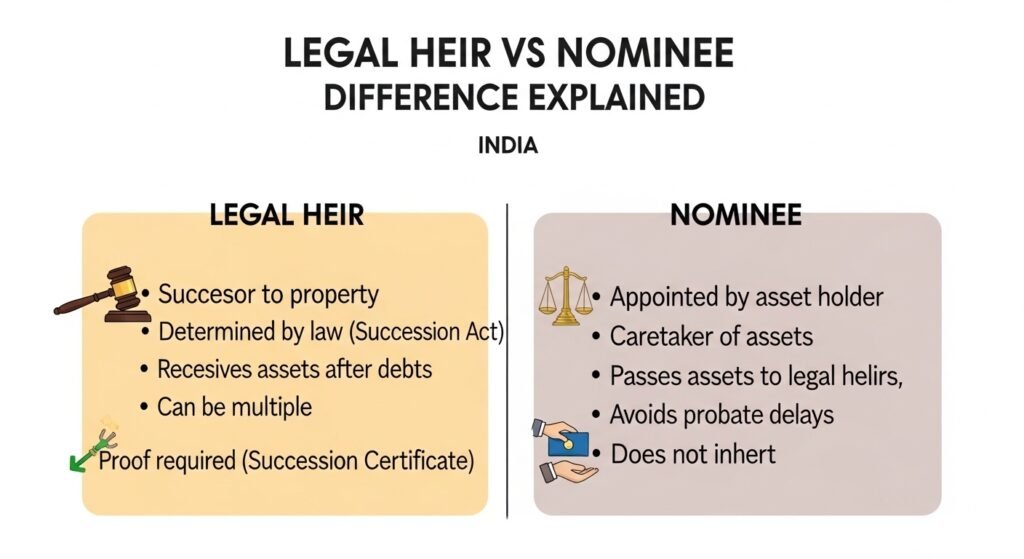
A legal heir is a person who is legally entitled to inherit the assets and property of a deceased individual under Indian law.
Who qualifies as a legal heir?
Legal heirs are determined based on succession laws such as:
- Hindu Succession Act
- Indian Succession Act
Common legal heirs include:
- Spouse
- Children
- Parents
- In some cases, siblings
What is a Nominee?
A nominee is a person appointed by the account holder or policyholder to receive assets after their death.
Where is a nominee used?
Nominees are typically assigned in:
- Bank accounts
- Insurance policies
- Mutual funds
- Employee benefits
Legal Heir vs Nominee Difference India (Core Explanation)
Understanding the legal heir vs nominee difference India is essential to avoid confusion.
Key Difference in Simple Terms
- Legal Heir: Actual owner of assets after death
- Nominee: Temporary custodian or trustee of assets
Detailed Comparison Table
Aspect | Legal Heir | Nominee |
Legal Status | Recognized by law | Appointed by individual |
Ownership | Final owner | Holds assets temporarily |
Authority | Based on succession laws | Based on nomination form |
Role | Inherits property | Transfers assets to legal heirs |
Disputes | Can claim rights in court | Cannot override legal heirs |
Why Nominee is Not the Final Owner
One of the biggest misconceptions in India is that a nominee becomes the owner.
Reality check:
A nominee only acts as a trustee.
This means:
- They receive the asset
- They must distribute it to legal heirs
- They cannot keep it unless they are also a legal heir
Legal Framework Behind the Difference
The distinction between legal heir and nominee is supported by Indian laws and court rulings.
For more legal clarity, you can refer to the official government resource:
https://services.india.gov.in/
When Do Legal Heirs Get Priority?
Legal heirs always have the final authority in:
- Property ownership
- Wealth distribution
- Inheritance disputes
Even if a nominee is assigned, legal heirs can:
- Challenge ownership
- File claims in court
- Demand rightful share
When Does a Nominee Become Important?
Despite limitations, nominees play a critical role.
Importance of nominee:
- Quick access to funds
- Avoids delays in banking processes
- Helps in emergency financial situations
Legal Heir Certificate vs Nomination
Many people confuse these as well.
Legal Heir Certificate
- Issued by government authority
- Confirms rightful heirs
Nomination
- Done by individual
- Helps institutions identify recipient
Common Mistakes People Make
Understanding the legal heir vs nominee difference India helps avoid these errors:
Mistakes to avoid:
- Assuming nominee is the owner
- Not updating nominee details
- Ignoring legal heir documentation
- Not creating a will
- Appointing unrelated nominees without clarity
How to Avoid Family Disputes
Proper planning can prevent major conflicts.
Smart steps to follow:
- Always create a will
- Keep nominee details updated
- Inform family members about decisions
- Obtain legal heir certificate when needed
- Seek professional guidance
Why Professional Help Matters
Legal documentation can be tricky, especially when it involves inheritance laws.
At Draft My Documents, we are known as one of the best in working with legal documentation and support services.
We help you:
- Understand legal heir rights
- Draft affidavits and documents
- Apply for legal heir certificates
- Avoid legal disputes
Visit us at:
Shop No. 49, 1st Floor, Guru Gobind Singh Marg, Mulund Colony, Mulund West, Mumbai
Website: https://draftmydocuments.in/
Legal Heir vs Nominee Difference India in Property Cases
Property matters often create the biggest confusion.
Important point:
- Nominee may hold property documents
- Legal heir becomes actual owner
If disputes arise:
- Courts favor legal heirs
- Nominee must transfer ownership
Role of Will in This Difference
A will can override confusion between legal heir and nominee.
Why a will is important:
- Clearly defines ownership
- Reduces disputes
- Supports legal heirs
Without a will:
- Succession laws apply
- Legal heir gets priority
Quick Summary Points
- Legal heir is the rightful owner
- Nominee is only a caretaker
- Legal heirs can claim assets from nominee
- Nomination helps in quick processing
- A will is the best way to avoid confusion
Conclusion
Understanding the legal heir vs nominee difference India is not just legal knowledge—it is essential for protecting your family’s future.
While nominees help in smooth processing, they do not replace legal heirs. Ignoring this difference can lead to serious disputes and financial complications.
Take Action Today
Do not leave your family’s future to confusion. Take the right steps today by understanding your legal rights, updating nominations, and preparing proper documentation.
For expert assistance, trust Draft My Documents to guide you through every step with accuracy and professionalism.
Frequently Asked Questions
1. Can a nominee claim full ownership of assets?
No, a nominee only holds assets temporarily and must transfer them to legal heirs.
2. Who has more power legal heir or nominee?
Legal heir has more authority as they are the rightful owner under law.
3. Is nominee necessary if there is a will?
Yes, it helps in faster processing, but the will determines final ownership.
4. Can legal heirs challenge a nominee?
Yes, legal heirs can legally claim assets from a nominee.
5. What is the safest way to avoid disputes?
Creating a will and maintaining clear documentation is the safest approach.
If you want to avoid confusion and ensure smooth legal processes, Draft My Documents is here to help you every step of the way.
Categories
- Sale Deed
- Gift Deed
- Release Deed
- Power of Attorney
- Leave & License Agreement
- Will
- Succession Certificate
- Legal Heir Certificate
- Adjudication
- Affidavit
- Indemnity Bond
- Property Search Report
- Old Document Clearance
- Property Valuation
- Property Title Clearance Certificate
- Stamp Duty & Registration
- Home Loan Assistance
- Loan Against Property
Latest Post
Society NOC Drafting Service in Mumbai: What You Need and What a Society Can Charge

Property NOC Document in Mumbai: Types, Documents Required
Property NOC Drafting Service in Mumbai: Types, Documents and How to Choose

No Objection Certificate Drafting in Mumbai

NOC Drafting Service Mumbai: How It Works and What to Expect

NOC Drafting Service in Mumbai

Legal Loan Document Review: Protect Your Property and Your Rights