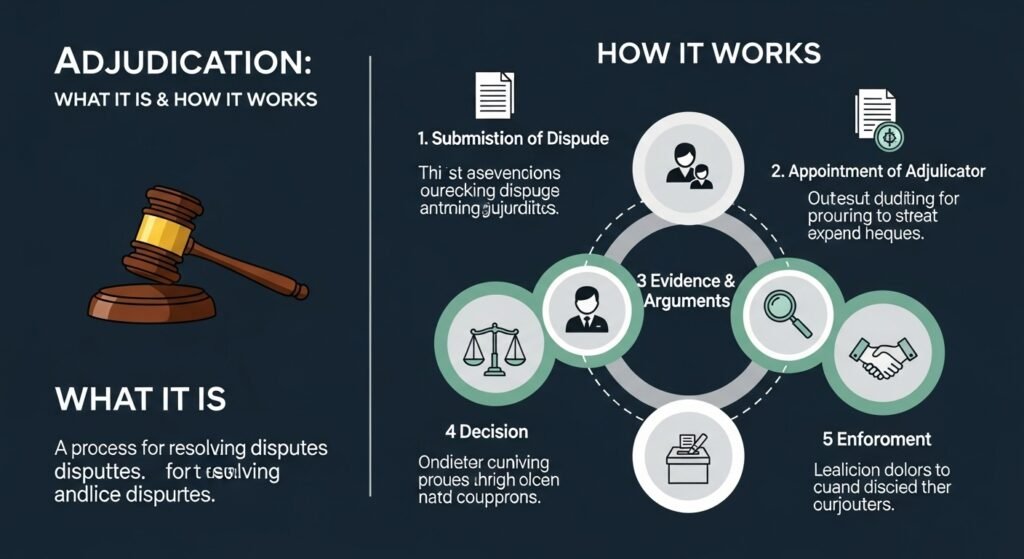
Introduction of Adjudication
In the world of law and dispute resolution, adjudication is a powerful concept—one that can settle conflicts, define rights, and deliver binding decisions. But for many, adjudication remains a vague term used by judges, lawyers, or bureaucrats. What exactly is adjudication? How does it differ from arbitration or mediation? And how can parties engage with it effectively?
In this post, we’ll break it down in a conversational, step‑by‑step way. You’ll learn:
The definition and core principles of adjudication
Different contexts where adjudication applies
The typical adjudication process
Key legal safeguards and challenges
Practical tips for using adjudication wisely
By the end, you’ll not just understand adjudication—you’ll know when and how to use it. Let’s dive in.
What Does “Adjudication” Mean?
It refers to the legal process of resolving a dispute or deciding a case by applying rules of law to facts and issuing a binding decision. Wikipedia
At its core, it includes:
A formal hearing or procedure
Presentation of evidence or argument
Decision-making by an adjudicator, judge, or agency
Issuance of a judgment, order, or decree
In U.S. administrative law, it is the process through which agencies resolve individual claims, license matters, or enforcement issues.
Why Adjudication Matters
It plays a critical role in law and governance. Here’s why it matters:
Binding decisions: Unlike mere negotiation or mediation, it produces a decision that parties must generally respect (subject to appeal).
Legal clarity: It resolves uncertainty about rights and obligations.
Enforcement backing: The decision can usually be enforced via courts or sanctions.
Efficiency: In some contexts, it is faster and less costly than full trials.
Versatility: It is used across many fields—civil, administrative, tax, corporate, construction, and more.
For example, under the Insolvency & Bankruptcy Code in India, the Adjudicating Authority (e.g., the National Company Law Tribunal) is central to insolvency proceedings.
In tax law (e.g., GST in India), an adjudicating authority issues show-cause notices and final orders, applying principles of natural justice in the process.
Types & Contexts
It is not one monolith. Different legal systems and fields use it differently.
1. Judicial
This is the traditional court process where judges hear disputes, apply law, and issue final judgments.
2. Administrative
Government agencies may adjudicate claims (e.g., benefits, licenses, sanctions) under statutes. For example, agencies under the U.S. federal system use adjudication to resolve disputes under the Administrative Procedure Act.
3. Contractual / Statutory
In certain sectors—especially construction—contracts or statutes may require disputes to go through adjudication rather than courts or arbitration.
In UK construction law, the Housing Grants, Construction and Regeneration Act grants parties the right to refer disputes to adjudication. Wikipedia
It is often “interim binding” in construction, meaning it settles payment claims quickly but may be revisited later.
4. Claims / Insurance
In insurance or benefits systems, adjudication describes the process of reviewing, approving, or denying claims. Wikipedia
5. Deferred / Conditional
In some criminal systems, a plea may lead to deferred adjudication, where the court delays entering formal judgment if the defendant meets certain conditions. Wikipedia
The Process: Step by Step
While the specific steps depend on jurisdiction and context, the general framework is as follows:
Notice / Initiation
The process usually begins when one party (the Claimant) gives notice to the other (Respondent), specifying the dispute and desired remedy.Appointment of Adjudicator / Authority
it (or panel) is selected—contractually, by agreement, or by a nominating body.Submission of Evidence / Arguments
Parties submit documents, witness statements, affidavits, and legal arguments.Hearing / Oral Arguments (if applicable)
Some processes require an oral hearing or cross-examination.Deliberation & Decision
The adjudicator reviews materials and applies law to issues raised.Issuance of Order / Determination
A reasoned decision or determination is published. In many construction adjudications, the adjudicator must issue within a statutory timeline (e.g., 30 days).Certification / Enforcement
The decision is certified, and any required compliance or payment must happen—often within a short period (e.g., 10 days).Challenge / Appeal (if allowed)
In some systems, the decision may be challenged or reviewed by a court or appellate body.
Timeline Example (Construction Adjudication)
Day 0: Notice of adjudication served
Day 1–4: Parties choose adjudicator
Day 5: Claimant submits documents
Day 30: Adjudicator issues decision
Day 7: Certification of decision
Day 10: Payment / compliance due
Legal Safeguards & Principles
Certain legal protections and rules must be respected to ensure fairness and legitimacy.
Principles of Natural Justice
These include:
Nemo judex in causa sua (No one as judge in his own cause)—the adjudicator must be impartial and unbiased.
Audi alteram partem (Right to be heard)—parties must have notice and an opportunity to present their case.
These principles are foundational in quasi-judicial or administrative adjudications, such as in tax/GST matters.
Jurisdiction & Authority
An authority must have the correct legal jurisdiction and power to decide the dispute. Orders made without jurisdiction can be challenged as invalid.
In GST adjudication, for example, show-cause notices and final orders must be issued by properly appointed officers.
Reasoned Decision & Speaking Order
Most systems require that the adjudicator’s decision be reasoned (i.e., explaining findings and legal basis), not a bare directive. In administrative adjudication, transparency matters.
Finality vs. Review
Some adjudications are final (non‑appealable), while others allow court review. Construction adjudication often produces an interim binding decision subject to later review.
Advantages & Limitations
Understanding both sides helps you decide when to use it.
Advantages
Speed: quicker than full trial or litigation
Cost-effective: less procedural overhead
Interim Relief: especially in construction for payment claims
Binding (with enforcement power)
Flexibility: procedures can be more informal
Limitations / Risks
Limited scope: only certain disputes can be adjudicated
Potential uncertainty: in interim binding regimes
Less full evidentiary rigor
Possible appeal/review doesn’t exist in all systems
Risk of partiality if safeguards are weak
Practical Tips: How to Prepare for Adjudication
If you’re entering it, here’s what you should do:
Understand your contract or statute’s clause.
Check timelines, appointment method, and scope.Serve a clear
State the dispute, relief sought, and the basis.Compile strong documentary evidence
Witness statements, contracts, correspondence, and reports.Organize submissions concisely
Many rules limit page count—stick to essential facts and legal points.Respond on time
Late submissions may be disregarded or penalized.Request oral hearing if permitted
It can help clarify contested points.Ensure the adjudicator acts impartially
Object if there’s bias or conflict of interest.Follow up on enforcement
After a decision, enforce by court or mandated process.Plan for appeal or review
If allowed, prepare grounds for challenge (jurisdiction, procedure, reasonableness).
Adjudication in India: A Brief Look
In India, it appears in multiple legal areas:
Insolvency & Bankruptcy
The NCLT acts as the adjudicating authority under the IBC.GST / Tax
Adjudicating authorities issue notices, conduct hearings, and pass orders—subject to principles of natural justice.E‑Adjudication under Companies Act
As per recent amendments, proceedings under Section 454 (Companies Act) are done electronically via e‑adjudication modules.Quasi-judicial bodies & regulatory commissions
In various sectors (telecom, environmental, administrative), it is used for dispute resolution.
Because of these uses, having clarity on how adjudication works gives legal practitioners, businesses, and individuals a competitive edge.
Conclusion & Call to Action
Adjudication is a dynamic tool in modern dispute resolution. Whether in court litigation, administrative regulation, or construction contracts, it offers a route to binding decisions—but only if handled with care. By understanding its principles, process, strengths, and limitations, you can use it smartly.
If you’re facing a complex contract dispute or regulatory issue or need help structuring a notice or response, I’d be glad to assist. Reach out, and let’s bring clarity and legal rigor to your journey.