
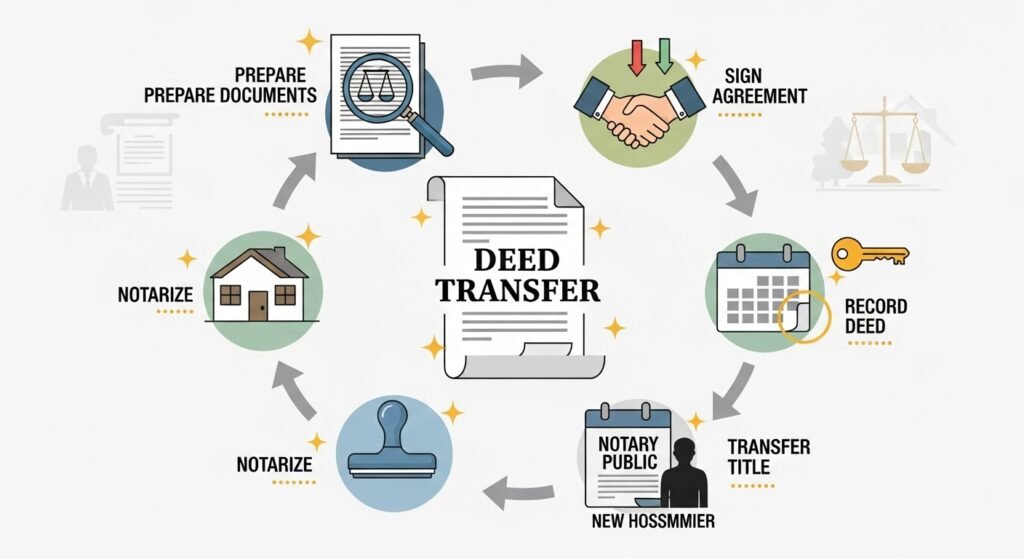
Transferring property ownership is a major legal step, and mistakes during the process can lead to disputes, financial loss, or even invalid documentation. Whether you’re gifting a property to a family member, selling it, or transferring it due to inheritance, understanding the deed transfer process is essential.
In cities like Mumbai and across India, property documentation needs precision and compliance with state laws. That’s why property owners trust Draft My Documents, a leading Real Estate Legal Documentation Services provider, to ensure their deed transfer is accurate, legally compliant, and hassle-free.
This comprehensive guide will walk you through the deed transfer process, types of deeds, legal requirements, documents needed, common mistakes to avoid, and how expert documentation services ensure a smooth transfer.
A deed transfer is the legal process of changing ownership of a property from one person to another. The deed is a legally binding document that proves the transfer of title or ownership rights.
It becomes valid only when:
It is properly drafted
Signed by parties
Stamped with appropriate stamp duty
Registered with the local sub-registrar
Without proper execution, the property ownership remains unclear and can cause disputes later.
A deed transfer ensures:
Legal proof of ownership
Transparency in property transactions
Protection of buyer and seller rights
Clear transfer of rights to heirs or beneficiaries
Compliance with state property laws
In India, registration and documentation errors can delay the process or make the transfer invalid. That’s why expert assistance is crucial.
There are several ways property ownership may be transferred:
A Sale Deed is created when a property is sold from one person to another.
Property description
Sale consideration
Buyer & seller details
Transfer of ownership rights
Indemnity clauses
Payment details
Possession clause
Sale Deed transfer requires:
Full stamp duty payment
Registration with the sub-registrar
Compliance with local property laws
A Gift Deed allows property to be transferred without monetary consideration—typically to family members.
No income tax on gifts to blood relatives
Quick and easy documentation
Clear legal proof of gifting
Avoids future disputes
Gift deed also requires registration and stamp duty, though many states offer concessional rates for family transfers.
Used when a co-owner gives up their share in favor of another co-owner, often after inheritance or family settlement.
After a parent’s death
Among siblings
Between joint owners
Partitioned family property
This deed helps avoid disputes by legally giving up one’s rights in the property.
A property can legally pass to heirs through a Will. However, after the owner’s death, beneficiaries must complete the mutation and documentation process to update records.
To update municipal records
For property tax changes
To sell or further transfer the property
To legally establish ownership
This deed is used to divide a jointly owned property into separate portions. The ownership of each portion is clearly defined.
A POA itself does not transfer ownership, but it authorizes someone else to complete property-related actions.
However, to change actual ownership, a deed transfer through sale, gift, or release is still required.
Transferring ownership involves several legal steps. Missing even one can cause delays or rejection at the registrar office.
Based on the purpose, choose:
Sale deed
Gift deed
Release deed
Transfer through Will
Partition deed
Choosing the wrong type can create legal complications.
This is the foundation of a valid deed transfer.
A professionally drafted deed ensures:
Legal compliance
Accurate clause placement
Proper property description
Smooth registration
Draft My Documents specializes in accurate drafting based on state laws and your exact requirements.
Stamp duty varies depending on:
Property location
Relationship between parties
Type of deed
Market value of the property
Incorrect stamp duty can invalidate the deed.
You must register the deed to make it legally valid.
At the sub-registrar’s office:
Parties must be present
Witnesses must sign
Thumb impressions are taken
Biometric verification is done
A registered deed is the strongest proof of ownership.
After deed transfer, update:
Property tax records
Municipal records
Society records (if applicable)
This ensures utility bills and taxes reflect the new ownership.
Here is a complete list:
Aadhar cards of parties
PAN cards
Passport-size photos
Address proof
Previous title deed
Index II (for Maharashtra)
Property tax receipts
Society NOC
Encumbrance certificate
Approved building plan
Relationship proof (for gift deed)
Legal heir certificate (for inheritance)
Death certificate (if applicable)
Partition agreement
Sale agreement
Having incomplete documents can delay the registration process. Draft My Documents ensures all paperwork is complete.
Costs depend on:
Stamp duty
Registration fee
Professional drafting charges
Attestation charges
Lawyer consultation fees
Getting the right estimate beforehand helps avoid surprises.
Avoid these to ensure a smooth process:
Each type of deed has a legally prescribed structure.
A single mistake in survey number or address can cause rejection.
Leads to penalties and legal issues.
Fraud and disputes increase when documents are not verified.
Transfers done without legal guidance often need correction later.
Without mutation, property ownership remains incomplete in government records.
Transferring a property deed is not just a paperwork task—it involves legal compliance and accuracy.
Professional documentation services help with:
Identifying the correct type of deed
Drafting the deed correctly
Calculating stamp duty
Preparing required documents
Ensuring seamless registration
Updating property records post-registration
DIY deed transfer often leads to errors, delays, and even legal disputes.
Draft My Documents is one of India’s leading Real Estate Legal Documentation Service providers, offering:
All deeds are drafted by experienced legal professionals.
From drafting to registration to mutation.
Transparent and budget-friendly services.
Fast drafting and easy scheduling.
Zero guesswork or mistakes.
Specialized in Mumbai, Thane, Navi Mumbai & Maharashtra property laws.
Online drafting, document uploads, and WhatsApp support.
Experts understand the purpose of the transfer and suggest the right type of deed.
Accurate drafting based on legal standards.
Ensuring all required documents are complete.
Guidance for stamp duty payment, slot booking, and registrar visit.
You receive Index II and registered copies.
Assistance with municipal and society records.
This service is ideal for:
Property buyers
Property sellers
Parents gifting property
Children transferring inherited property
Siblings sharing inheritance
Co-owners dividing a property
Landlords
Real estate investors
NRIs who need remote documentation support
Yes, you must execute a transfer document and complete mutation.
Drafting and document preparation can be done online, but registration must be done in person.
A rectification deed must be executed.
With correct documents, it can be completed within a few days.
Yes, through an notarized & attested POA.
A deed transfer is a crucial part of property ownership—and it must be done correctly to avoid future legal problems. Whether you’re transferring property through sale, gift, inheritance, or family settlement, the right documentation ensures complete legal safety.
With Draft My Documents, you get expert drafting, guidance, and end-to-end support for a flawless deed transfer process.
Contact Draft My Documents Today!
Get expert drafting, stamp duty support, and seamless registration—anytime.



WhatsApp us